(A note before we get into it: this article is educational, not medical advice. Talk to your doctor or a registered dietitian before making major changes to your diet — especially if you have diabetes or pre-diabetes, take blood-sugar medication, are pregnant or nursing, or are managing any chronic condition. Nothing here is intended to diagnose, treat, cure, or prevent any disease.)
Research shows well-built plant-based diets usually lower blood sugar. If yours moved the other way, one of six silent glucose traps is almost always the reason — and every one of them is fixable.
TLDR
The research is actually on vegetarianism’s side. Large reviews of clinical trials show vegetarian and vegan diets tend to lower A1C, not raise it.
So if your numbers went up, something in how the diet was built is the real cause — not the fact that it’s plant-based.
Six usual suspects: too little protein, “naked” carbs with no brakes, shrinking muscle mass, too much fermentable fiber too fast, high stress/cortisol, and late-night eating.
Each one is a fixable habit, not a reason to abandon vegetarianism.
Wait — Doesn’t “Plant-Based” Mean Healthier Blood Sugar?
Usually, yes. When researchers actually put vegetarian diets to the test in clinical trials, the pattern is consistent: people following them tend to see their A1C go down, not up. A meta-analysis pooling multiple randomized trials found vegetarian diets were linked to a meaningful drop in A1C, and a separate meta-analysis of nine trials found a similar reduction — enough that it would be considered clinically significant by the FDA’s own bar for new diabetes drugs.
So if you switched to vegetarian eating and your last lab draw came back worse, I want to be straight with you: that’s not the expected outcome, and it’s not “just what happens” when you cut out meat. Something specific is working against you. The good news is that it’s almost always one of a handful of well-understood mechanisms — and once you know which one, it’s a quick fix, not a diet overhaul.
Think of it like this: a car engine doesn’t run worse because you switched to a different brand of gas. It runs worse because something specific — a clogged filter, bad timing, low oil — is getting in the way. Same idea here. Let’s go through the six most common “clogs.”
1. The Protein Drop You Didn’t Notice
This is the single most common one. When people cut out meat, they usually don’t replace that protein gram-for-gram with plant protein — they replace it with more carbs, because carbs are what fill the plate: extra rice, extra bread, extra pasta.
Here’s why that matters for blood sugar specifically. Protein eaten alongside carbohydrate isn’t just “extra food” — it changes how your body handles the carbs. A meta-analysis of controlled feeding trials found that adding protein to a carb-containing meal meaningfully lowers the post-meal glucose spike, largely by boosting the insulin response that clears sugar out of the bloodstream faster. Pull protein out of the meal and carbs hit your blood essentially unguarded.
Think of protein as the brakes on a sugar rollercoaster. Take the brakes off, and the same carbs you were eating before now send your blood sugar higher and faster than they used to.
2. Naked Carbs, No Brakes
This is the same problem from a different angle: oatmeal for breakfast, a rice bowl for lunch, a smoothie for a snack. All reasonable foods — but if none of them are paired with enough protein or fat, and you’re not about to go move that sugar with a workout, it hits your bloodstream as a fast, unbuffered spike. Your body answers with a bigger insulin surge, and doing that meal after meal, day after day, is exactly the pattern linked to declining insulin sensitivity over time.
3. The Muscle Factor
This one surprises people: your muscles are the biggest “storage tank” for the sugar you eat. After a meal, skeletal muscle soaks up roughly 70–80% of the glucose that comes out of your bloodstream, using it to refill glycogen stores. Researchers who study this consider muscle glucose uptake the single biggest lever on whole-body insulin sensitivity.
So when protein intake drops and resistance training isn’t part of the picture, muscle mass tends to shrink over time — and that storage tank gets smaller. Less tank space means the same meal now leaves more sugar circulating in your blood for longer, which shows up as a slow, creeping rise in A1C.
Muscle is basically your body’s biggest gas tank for sugar. Shrink the tank, and the same fill-up overflows.
4. High Fiber, High Stress
Fiber itself is not the villain here — in fact, the right kind of fiber is one of the best tools for blood sugar control. Viscous, soluble fibers (found in oats, beans, and psyllium) form a gel in your gut that physically slows down how fast sugar gets absorbed, and trials show this type of fiber measurably lowers both A1C and fasting blood sugar.
The issue is a different kind of fiber problem: volume and speed. Vegetarian diets are often naturally high in fermentable fiber — beans, lentils, certain grains — and when your gut bacteria break that fiber down, the fermentation process produces gas as a byproduct. Ramp up fiber intake quickly, especially the fast-fermenting kinds, and you can outpace your gut’s ability to comfortably process it, leading to bloating and discomfort. That physical stress on your body, especially combined with everyday life stress, triggers cortisol release — and cortisol has a direct, well-documented job of raising blood glucose by signaling your liver to make more sugar and by making your cells less responsive to insulin.
Think of fiber fermentation like a construction project in your gut. The building itself (your microbiome) benefits — but a project moving too fast kicks up a lot of dust (gas and bloating) along the way.
5. Timing and Circadian Rhythms
The lifestyle shift that often comes with going vegetarian — more grazing, more small meals, more snacking — can quietly push more of your eating into the evening. That timing matters more than most people realize. Multiple studies using identical meals given at different times of day have found that the exact same meal produces a bigger blood sugar spike at night than it does in the morning, because your insulin sensitivity and beta-cell function both naturally dip in the evening. One study even found a late meal after 8pm was independently linked to worse A1C.
Your body runs on a work shift for carbs. The day shift (morning, early afternoon) handles them efficiently. The night shift is running on a skeleton crew — the same carb load left unprocessed for longer, working against you while you sleep.
6. Cortisol: The Common Thread
You’ll notice cortisol keeps coming up — that’s not a coincidence. Cortisol’s actual job during stress is to make more glucose available fast, by triggering your liver to produce it and by directly blunting how well your cells respond to insulin. Whether the stressor is emotional (a hard week at work) or physical (a gut that’s working overtime to ferment more fiber than it’s used to, or a body that’s lost muscle mass and is struggling to regulate blood sugar as efficiently), the hormonal response is the same: more sugar released, less efficiently cleared.
Who’s Most Likely to Notice This?
Not everyone who goes vegetarian sees their A1C move. The people most likely to notice these effects are those who already have some combination of insulin resistance, chronic stress, poor sleep, low muscle mass, or a sensitive gut. For them, a vegetarian diet doesn’t cause the problem — it tends to reveal a metabolic bottleneck that was already there, quietly, underneath a different diet.
This isn’t a case against vegetarian eating. The clinical research is genuinely favorable toward it. It’s a case for building it correctly — with enough protein, the right kind and pace of fiber, resistance training to protect muscle, and carbs eaten earlier in the day, paired with something that slows them down.
Six Bottlenecks at a Glance
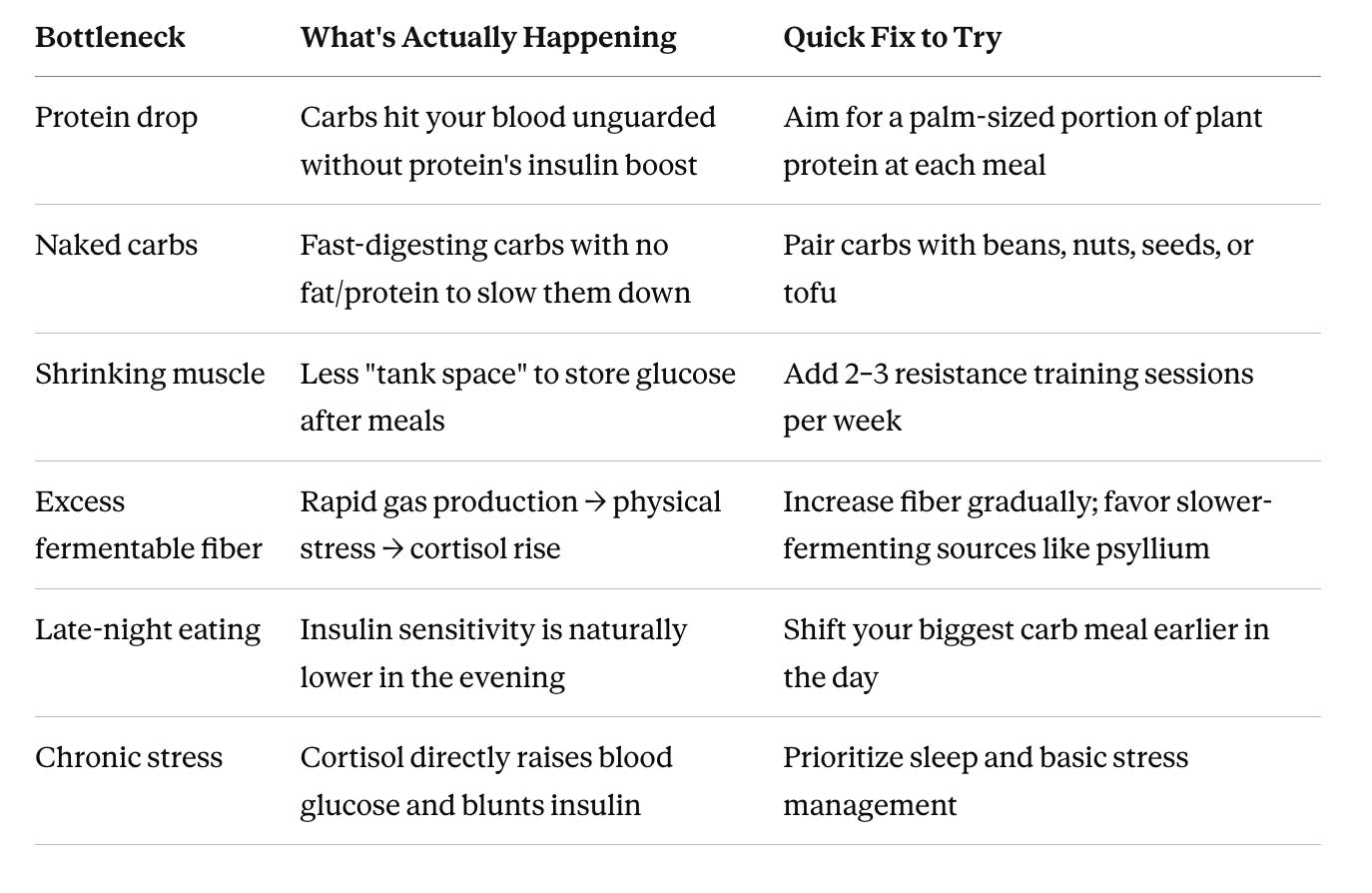
The Bottom Line
The question was never really “is vegetarianism good or bad for blood sugar?” — the research says it’s generally good when it’s built well. The real question is: what’s your body’s current metabolic bottleneck? Is it protein? Muscle? Fiber pacing? Timing? Stress? Most people are dealing with one or two of these more than the others, and once you know which, the fix is usually a small, specific adjustment — not throwing out the diet.
The goal isn’t just to tweak what’s on your plate. It’s to find the actual thing standing between you and the results you were expecting when you made this change in the first place.
References
Vegetarian and Vegan Dietary Patterns to Treat Adult Type 2 Diabetes: A Systematic Review and Meta-Analysis of RCTs — ScienceDirect: https://www.sciencedirect.com/science/article/pii/S2161831324001285
Vegetarian diets and glycemic control in diabetes: a systematic review and meta-analysis — PubMed: https://pubmed.ncbi.nlm.nih.gov/25414824/
The Effect of Adding Protein to a Carbohydrate Meal on Postprandial Glucose and Insulin Responses: A Systematic Review and Meta-Analysis — ScienceDirect: https://www.sciencedirect.com/science/article/pii/S0022316624003924
The Role of Skeletal Muscle Glycogen Breakdown for Regulation of Insulin Sensitivity by Exercise — Frontiers in Physiology: https://www.frontiersin.org/journals/physiology/articles/10.3389/fphys.2011.00112/full
Glucose Uptake by Skeletal Muscle within the Contexts of Type 2 Diabetes and Exercise — MDPI/Nutrients: https://www.mdpi.com/2072-6643/14/3/647
Effect of viscous soluble dietary fiber on glucose and lipid metabolism in patients with T2DM: systematic review and meta-analysis — PMC: https://www.ncbi.nlm.nih.gov/pmc/articles/PMC10500602/
Dietary fiber in irritable bowel syndrome (fermentation and gas production) — PMC: https://pmc.ncbi.nlm.nih.gov/articles/PMC5548066/
Fibre, fermentation, FODMAPs and flatulence — Quadram Institute: https://quadram.ac.uk/blogs/fibre-fermentation-fodmaps-and-flatulence/
Physiology, Cortisol — StatPearls, NCBI Bookshelf: https://www.ncbi.nlm.nih.gov/books/NBK538239/
Endogenous circadian system and circadian misalignment impact glucose tolerance via separate mechanisms in humans — PNAS: https://www.pnas.org/doi/10.1073/pnas.1418955112
Impact of circadian disruption on glucose metabolism: implications for type 2 diabetes — Diabetologia/PMC: https://pmc.ncbi.nlm.nih.gov/articles/PMC7002226/
Chronotype, Chrononutrition and Glucose Tolerance Among Prediabetic Individuals (late-dinner/A1C link): https://cdn.clinicaltrials.gov/large-docs/64/NCT05163964/Prot_SAP_ICF_004.pdf